Research
Formulating and implementing theory for quantum phenomena in materials
I build theoretical frameworks — and the code that makes them usable — to explain how quantum materials absorb light, emit light, and carry current without resistance. Three threads run through the work.
Theoretical spectroscopy
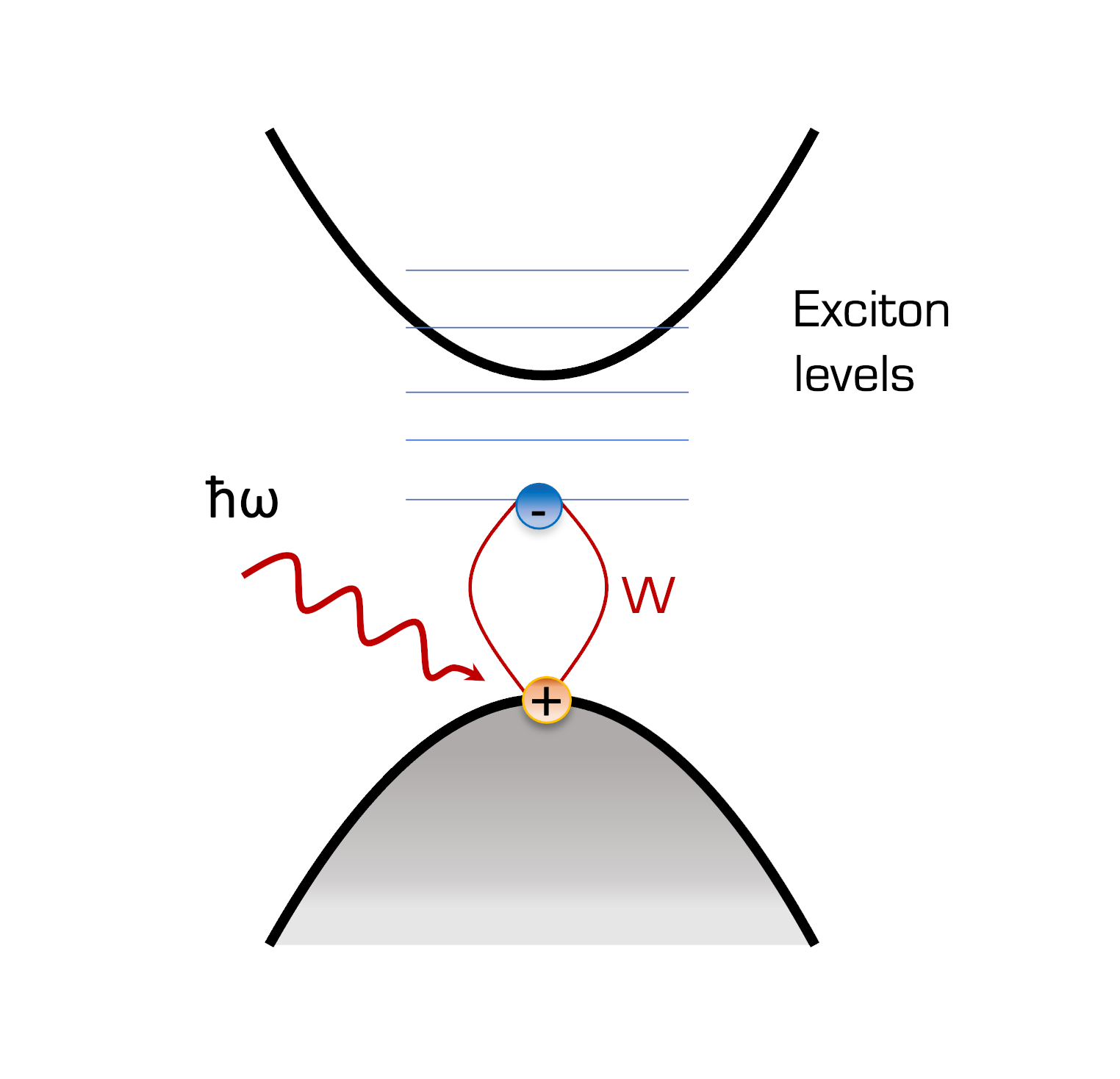
I study the optical properties of two-dimensional multilayer structures built from transition metal dichalcogenides (TMDs) and topological insulators such as Bi₂Se₃. Reduced dimensionality and dielectric screening enhance the Coulomb interaction between charge carriers, producing strongly bound electron–hole pairs — excitons — that dominate the optical response.
Concretely, I work on:
- Excitonic response of heterostructures — how stacking order, twist angle and interlayer distance reshape the exciton spectrum (Phys. Rev. B 110, 035118).
- Real-time photoluminescence from non-equilibrium many-body perturbation theory, implemented in the Yambo code.
- Ultrafast carrier dynamics in 2D Bi₂Se₃ nanoplatelets, in collaboration with experiment (ACS Nano 19, 17261).
Superconductivity
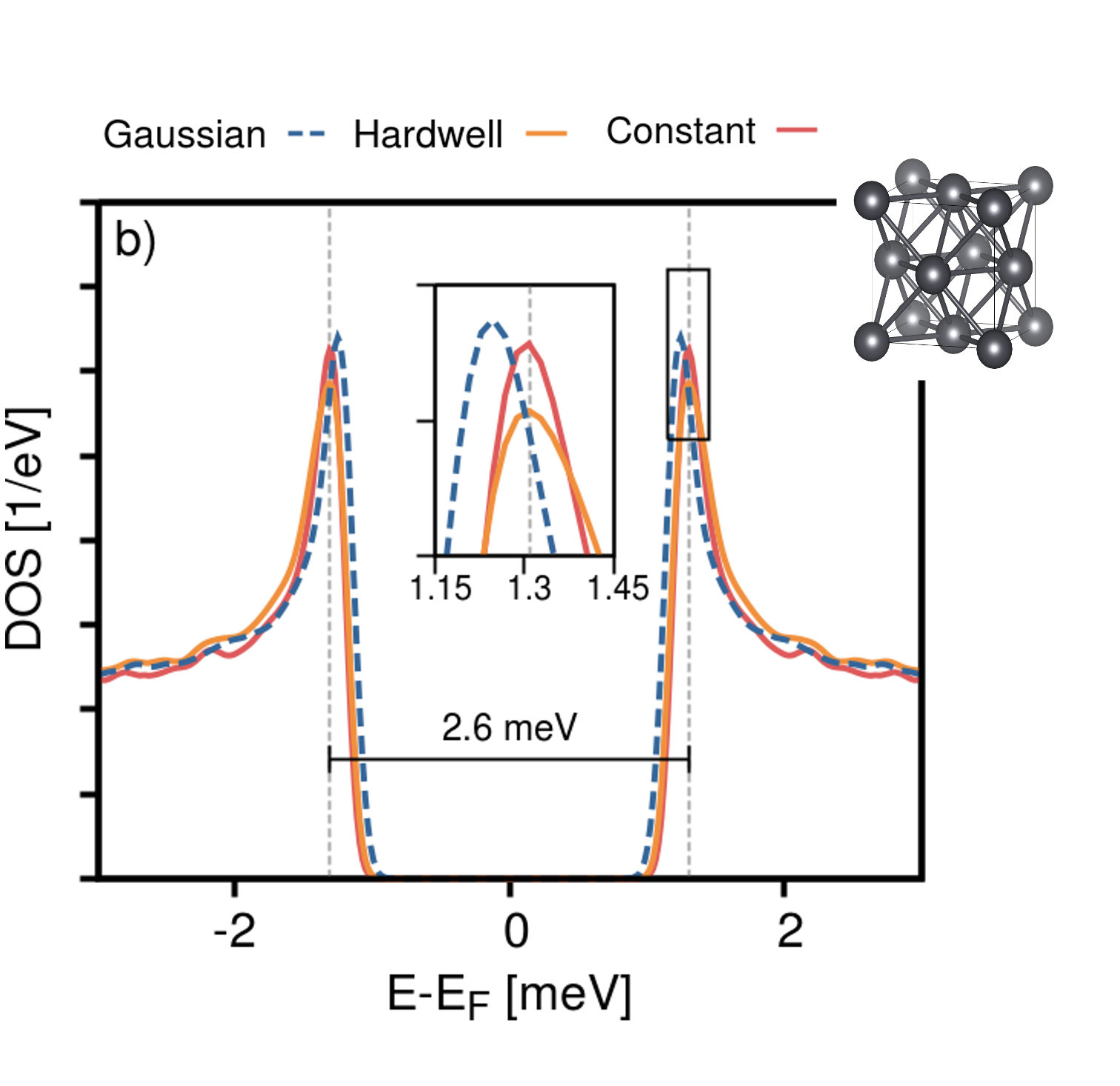
I combine Bogoliubov–de Gennes theory with density functional theory in a unified approach — density functional Bogoliubov–de Gennes theory (DFT-BdG) — which I extended to unconventional pairing and implemented in the SIESTA code (Phys. Rev. B 110, 134505).
Applications include proximity-induced superconductivity in semiconductor– superconductor heterostructures such as PbTe/Pb, relevant to topological quantum computing platforms (Phys. Rev. B 113 (2026)).
Topology in condensed matter
Berry curvature, Wannier functions and Chern numbers give a geometric reading of electronic and optical response. I use Wannier-based tight-binding models, interfaced with first-principles calculations, to connect microscopic band geometry to measurable spectra.
Codes and tools
| Code | Role |
|---|---|
| Yambo / yambopy | GW, BSE, real-time dynamics — developer |
| SIESTA | DFT-BdG for superconductors — developer |
| Quantum ESPRESSO | Ground-state DFT and phonons |
| Wannier90 | Maximally localised Wannier functions |
| AiiDA | High-throughput workflow management |